
At ISSHA, we value and support our early‑career researchers. To showcase their contributions to the study of harmful algae, this highlight series features research and recent work led by early‑career members of the society. This series aims to celebrate the breadth of harmful algae research and the people driving it forward.
—
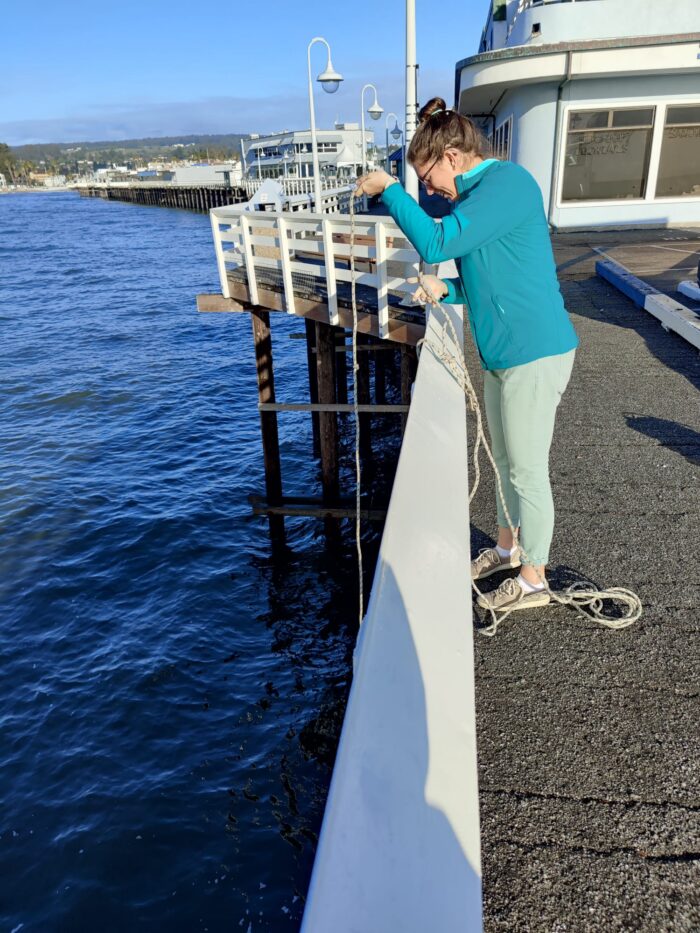
Aubrey sampling for copepods and copepodamides.
My name is Aubrey Trapp, and I am from the United States. I finished my
PhD last year at the University of California Santa Cruz in the Kudela lab. I
am currently working as a postdoctoral researcher at the Salish Sea Research
Center (SSRC) with Dr. Misty Peacock. The SSRC works on community identified environmental
research as part of Northwest Indian College within the Lummi Nation on the west
coast of Washington State.
What is your current research focus?
My current research focuses on harmful algal bloom monitoring and
seafood safety in the Salish Sea. I am especially interested in marine chemical
ecology and biological drivers of toxin production. For my postdoc, I’ll be
working on predator-prey interactions between copepods and PST producers. I’ve
also been using solid-phase adsorption toxin tracking (SPATT) to passively
sample dissolved chemicals such as toxins and grazer cues during HAB events.
What motivates you or inspires your work?
I am motivated to do research because I love being a scientist. Working
as a team to answer questions about the natural world and sharing our results
with the community is my dream job. I also feel inspired when I think about the
unanswered mysteries of plankton and all the humans around the globe who devote
their careers to understanding these small and mighty organisms.
What do you find the most exciting or challenging about your research?
My research is exciting because it is very interdisciplinary and our
results have real-world outcomes for people and animals who rely on shellfish
as a resource. My work includes field monitoring, lab experiments, computer
work, and training student interns, so every day is a little bit different.
You recently published a paper – what is the main message or results that you want people to know?
The paper was recently published in PNAS from a collaboration between UC Santa Cruz, Lund University, and the SSRC. Our study used SPATT passive sampling to include copepod cues (copepodamides) in weekly HAB monitoring in Monterey Bay, California. Over the 2.5 year study, we found that copepodamides signaled future increases of domoic acid and Pseudo-nitzschia cell counts. The results encourage further investigation into the inclusion of top-down toxin drivers in HAB monitoring and predictive models.
Link to paper: https://www.pnas.org/doi/10.1073/pnas.2604233123
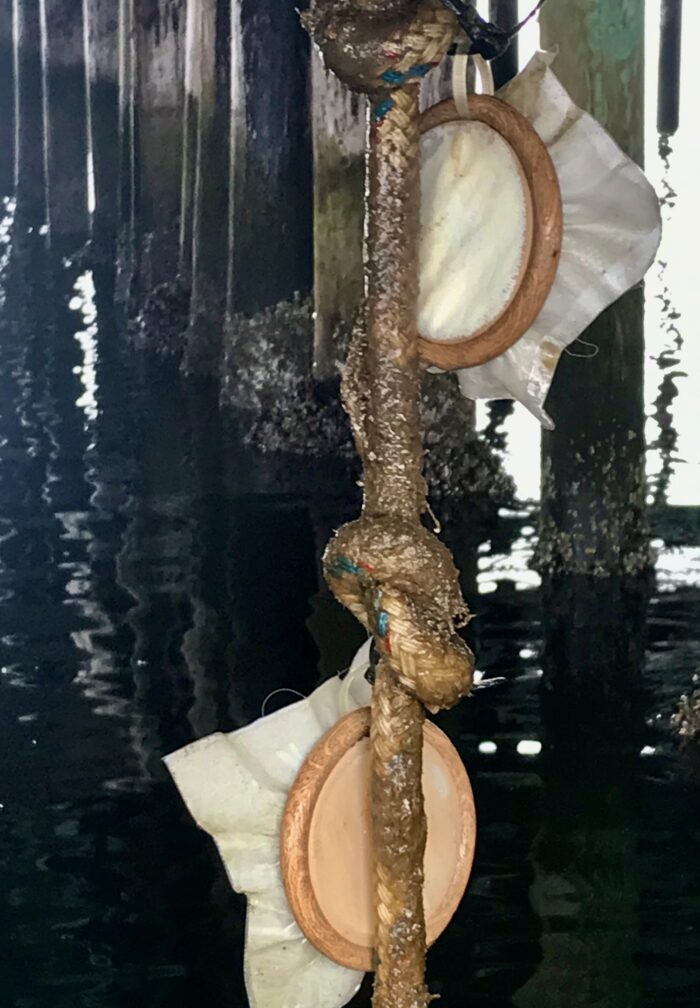
SPATTs deployed.
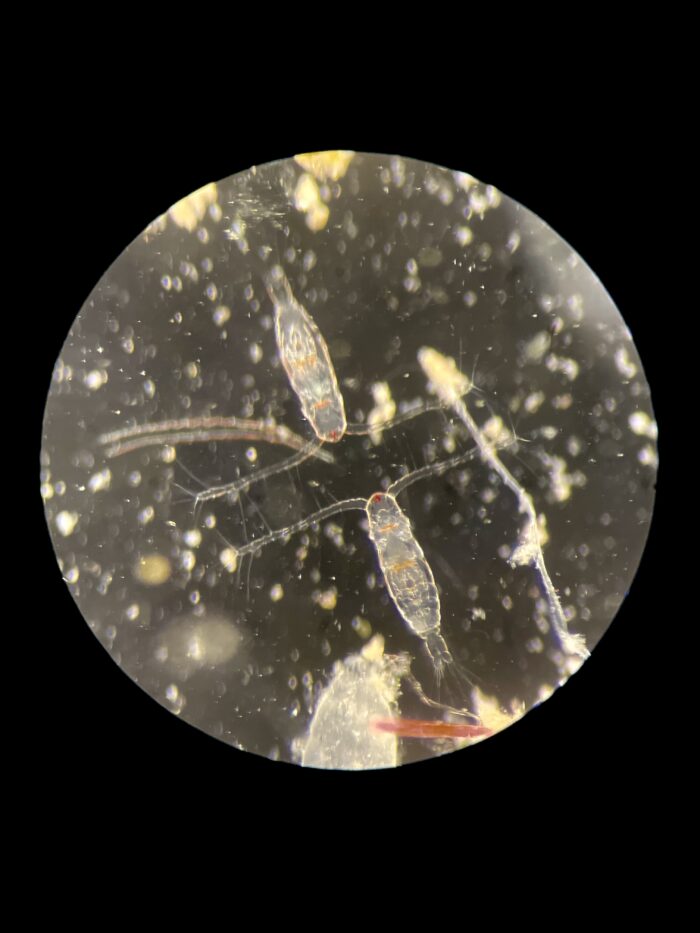
Copepods under the microscope.