At ISSHA, we value and support our early‑career researchers. To showcase their contributions to the study of harmful algae, this highlight series features research and recent work led by early‑career members of the society. This series aims to celebrate the breadth of harmful algae research and the people driving it forward.
—
My name is Carolin Peter and I am currently doing my PhD at the Linnaeus university in Kalmar, Sweden. While I am originally from Germany and did my Bachelor’s as well as Master’s at the university in Bremen, I also spent one year in Jyväskylä, Finland and took part in courses on Svalbard as part of UNIS (The University Centre in Svalbard).
Shortly after starting my PhD, I became the student representative for ISSHA, a role which I still have today.
What is your current research focus?
My focus is on the phytoplankton community of the Baltic Sea and within that on Nodularia spumigena. This nitrogen fixing filamentous cyanobacteria forms massive blooms in summer and is one of the main toxin producers in the Baltic. While nodularins are the main toxin, their profiles are quite diverse with additional aeruginosins, spumigins and anabaenopeptins. I am assessing how their toxicity (and growth and nitrogen fixation capabilities) is affected by changes in abiotic factors (temperature & salinity) as predicted for the future.
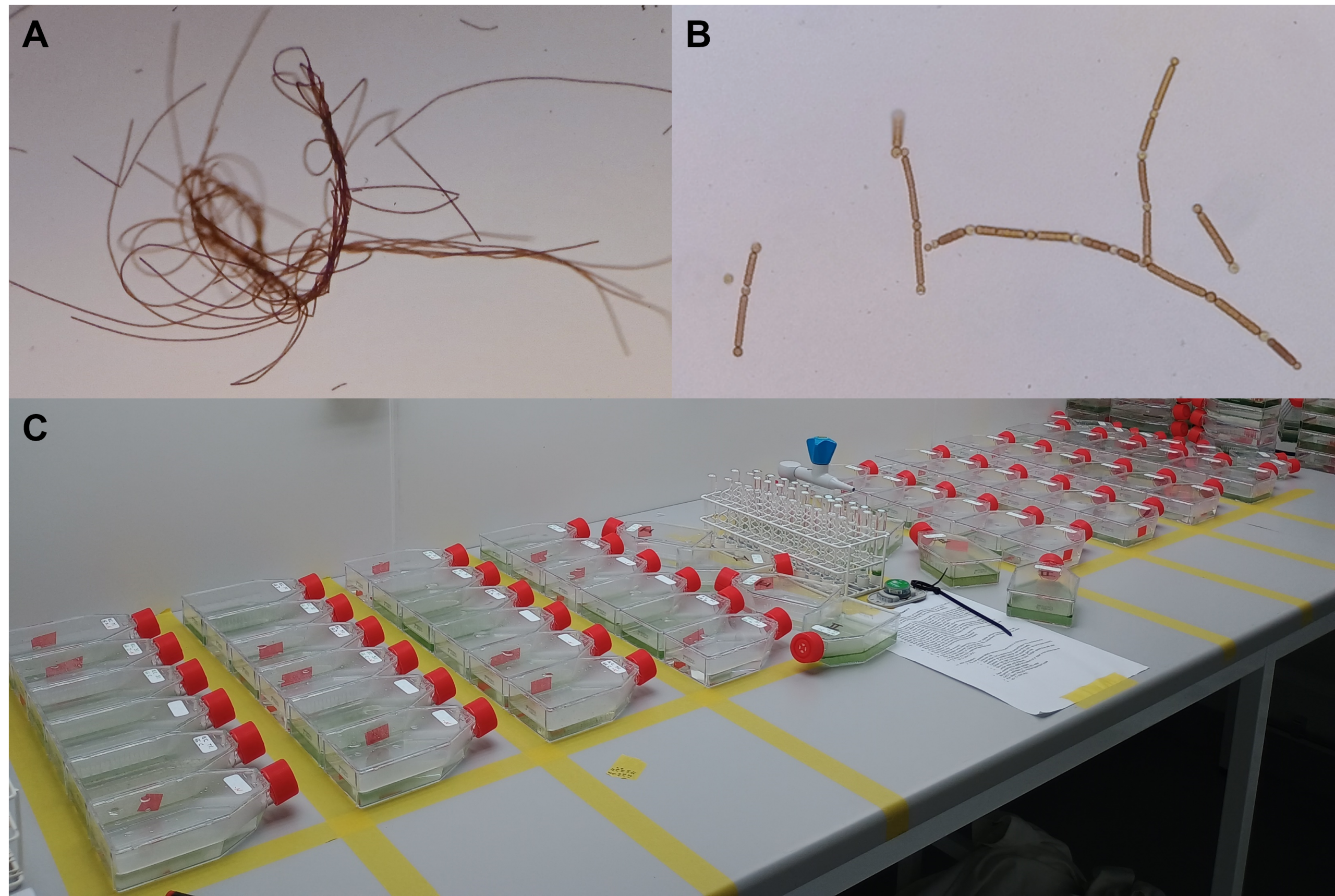
Nodularia spumigena strains KAC11 (A) & KAC66 (B); experimental set-up (C) © Carolin Peter
What motivates or inspires your work?
I have always been fascinated by the diversity of (phyto-)plankton and the multitudes of ways in which they interact. As basis for whole ecosystems, they are of such utmost importance and while their functioning is readily understandable on a surface level, the deeper one dives into it the more open questions one uncovers. Any changes on this base level can escalate through the whole food web and yet we still know so little about these organisms, especially with regards to toxin producers. What is the biological function of those toxins, what governs their production and determines post transscriptional modifications? How do different toxin profiles come to pass, what determines them and how stable are they?
Within ISSHA, I greatly appreciate the different perspectives each individual brings to the table based on their background and how bringing these together can nurture research and knowledge. The way I perceive it is one of “the whole is more than the sum of its parts”. I also greatly appreciate the opportunity to further the fascination with and enthusiasm for the study of harmful algae in the next generation of researchers.
What do you find the most exciting or challenging about your research?
While I do of course see the merit in field studies, I personally really enjoy culture work and observing directly how algae react to changes in their environmental conditions. However, this can also be incredibly frustrating. Working with live cultures can result in demanding schedules and long hours when everything needs to be geared towards their growth. If they behave unexpectedly or don’t grow without any indication as to what happened, it can throw whole plans off kilter, but if things work out it is great to see them grow and to observe how they change and adapt to their environment.
You just recently completed an experiment – what did you learn or discover?
I recently finished a large experiment which is part of an acclimatisation set-up that was started more than a decade ago. I have two different strains of N. spumigena acclimatised to different temperatures and salinities. As part of my experiment, I am assessing their growth rates, toxicity, nitrogen fixation and morphology. While the experiment itself is completed, sample processing and data analysis is still ongoing. I can thus not yet make a statement on the effects of temperature and salinity on their toxicity, but I did observe great phenotypic plasticity while adapting to a changing environment. It was also revealed that even after all these years of being supplied with nitrate as part of the media formula, they are still capable of growing without nitrogen additions.
—
Are you an early career member of ISSHA and want to share your research? Please contact us!