
At ISSHA, we value and support our early‑career researchers. To showcase their contributions to the study of harmful algae, this highlight series features research and recent work led by early‑career members of the society. This series aims to celebrate the breadth of harmful algae research and the people driving it forward.
—
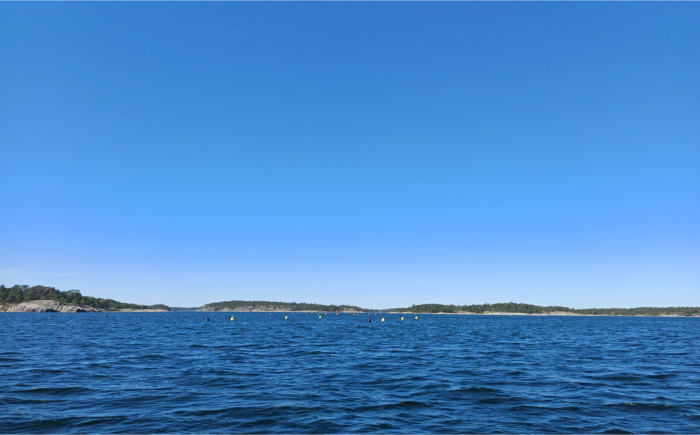
A mussel farm in the Baltic Sea where Manuela and her coworkers investigated the mussels and surrounding waters for cyanotoxins. © Manuela Seehauser.
Hi! My name is Manuela, I was born and raised in Italy and currently living in Stockholm, Sweden. I am in my third year of my PhD studies in Microbial Ecology at SLU in Uppsala. I did my Bachelor and Master studies at the University of Innsbruck (Austria) with a specialization in microbiology.
What is your current research focus?
My research focuses on toxic cyanobacterial blooms in the Baltic Sea. More specifically, I investigate cyanotoxins at and around mussel farming sites to understand their dynamic and seasonality with regard to their accumulation in seafood. I seek to decipher when and which cyanotoxins are produced and assess their potential impacts on mussel aquaculture practices in the Baltic Sea, today and in the future.
What motivates or inspires your work?
As a microbiologist, I am fascinated by microbes, their interactions, and the impact they have on both the environment and human society. I am curious and like to explore the unknown and answer open scientific questions. What motivates me most in my project is the opportunity for stakeholders and, ultimately, society to benefit from my research by developing and applying strategies to manage toxic cyanobacterial blooms and adapt aquaculture practices accordingly.
What do you find the most exciting or challenging about your research?
The most exciting part of my research is the combination of fieldwork and laboratory work. I enjoy applying different methods to answer research questions and studying cyanobacteria across several scales, from controlled laboratory experiments to large and complex ecosystems such as the Baltic Sea. The most difficult aspect of my research is understanding the intricate interactions between toxic cyanobacteria and their environment and integrating these processes into a coherent overall picture.
You’re starting a new project – what are you most excited to explore?
I am currently planning a new project that will expose cyanobacteria to different climate change–related stressors in laboratory experiments. I am most excited to explore how these stressors may affect cyanobacterial toxicity and what the broader implications could be in the context of climate change.
—
Are you an early career member of ISSHA and want to share your research? Please contact us!