Sam Murray
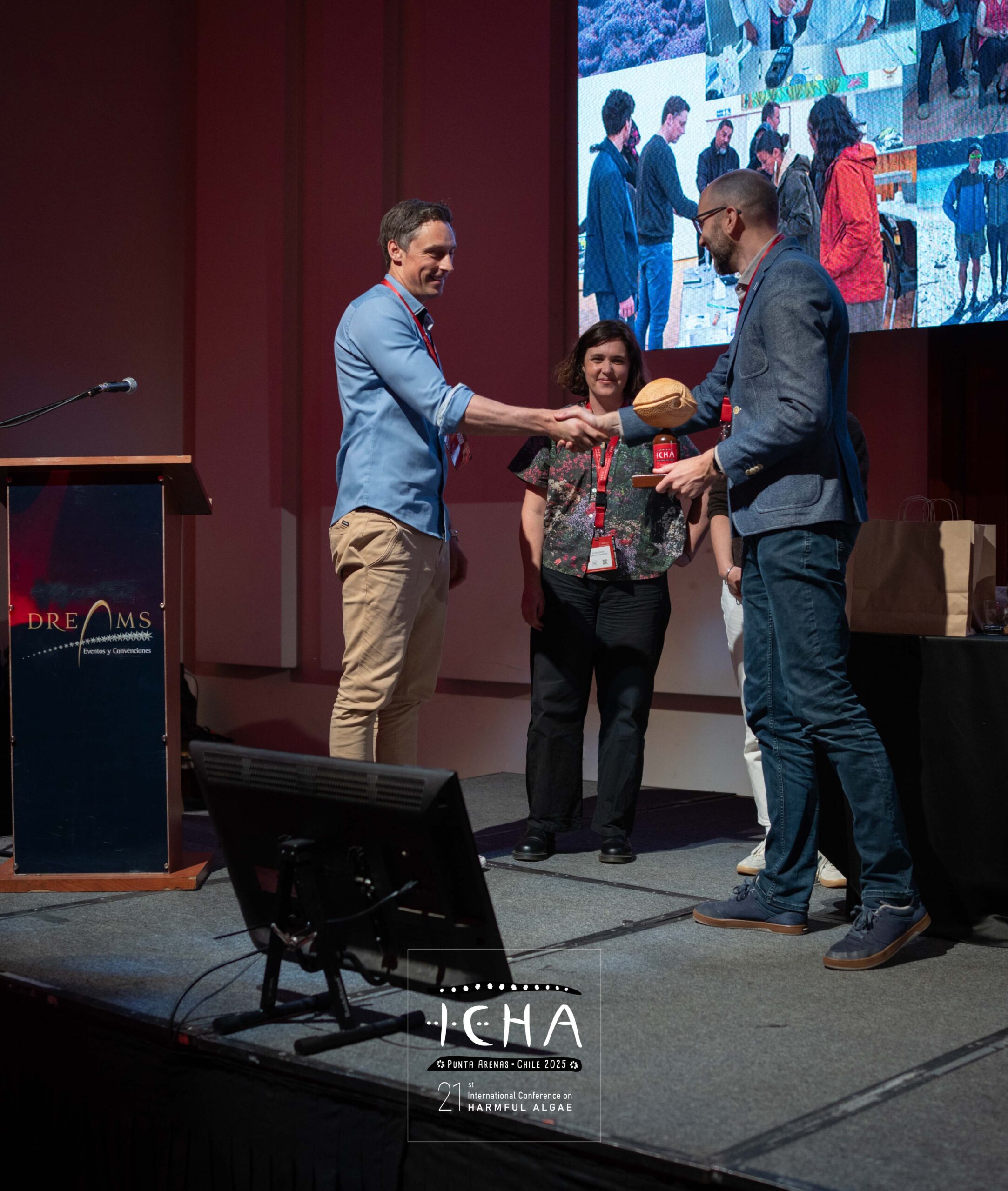 The ISSHA 2025 Patrick Gentien Young Scientist Award was won by Sam Murray (Cawthron Institute, New Zealand) for his outstanding and balanced contributions to HAB research, notably including his research on ciguatera poisoning, his involvement in national efforts for risk assessment, and his work in training local and Indegenous communities for rapid food safety assessment tools. He has proven to be an impactful, collaborative and enthusiastic young scientist. His nomination was led by Lesly Rhodes and presented during the award ceremony at ICHA 2025 by Kirsty Smith.
Sam Murray was awarded his PhD in 2022 for his thesis on the identification and structural elucidation of toxins associated with ciguatera poisoning. Since then, in his postdoctoral research, he has continued to focus on this critical area, making significant contributions to the scientific understanding of toxins produced by benthic dinoflagellates. Sam is an active member of the harmful algal bloom (HAB) research community, regularly attending ICHA conferences and recently initiating collaborative projects with scientists in Germany, Spain, Canada, and several Pacific Island nations. He is particularly recognized for 1) his impactful research on ciguatera poisoning, supporting the resilience and self-sufficiency of Pacific Island communities, 2) his involvement in New Zealand’s national efforts to assess the risks of ciguatoxin-producing organisms in the rapidly warming northern coastal waters of Aotearoa New Zealand and 3) his work training local and Māori communities in northeastern Aotearoa New Zealand in the use of rapid screening tools for assessing the safety of recreationally harvested shellfish.
Dr. Murray exemplifies scientific excellence, regional leadership, and a deep commitment to community-centered research. His work spans the ecological, toxicological, and public health dimensions of HABs, with a particular focus on the dinoflagellates Gambierdiscus and Fukuyoa, the primary organisms responsible for ciguatera poisoning. His interdisciplinary approach has significantly advanced understanding of the distribution and behavior of these toxic algae in tropical and subtropical reef ecosystems across the Pacific. He maintains a strong commitment to Pacific Island communities, where ciguatera poisoning remains an under-recognized yet persistent public health challenge. He has led numerous collaborative projects with local institutions in Fiji, Tonga, the Cook Islands, and Kiribati. These initiatives aim to build local capacity for ciguatera monitoring, develop culturally appropriate risk communication tools, and inform regional fisheries policy. His work directly supports food security and public health resilience in some of the Pacific’s most vulnerable coastal populations. This is also exemplified by his contributions to strengthening laboratory capabilities in Papua New Guinea, the Solomon Islands, Fiji, and Kiribati. His support includes delivering hands-on training and helping to implement quality assurance systems and chemical testing methods tailored to the needs of each country. His emphasis on sustainability and local ownership ensures that scientific capacity remains embedded within the communities he supports.